Brazilian Music Publications

ARTICLES PUBLISHED  BY JULIANA AREIAS

Serie of articles explaining the connection between Brazilian Music and Brazilian History and its relevance to the world -  written by Juliana Areias  and published at the Brazilian-Australian Falamos Portugues Magazine (DRT Publishing Pty Ltd).

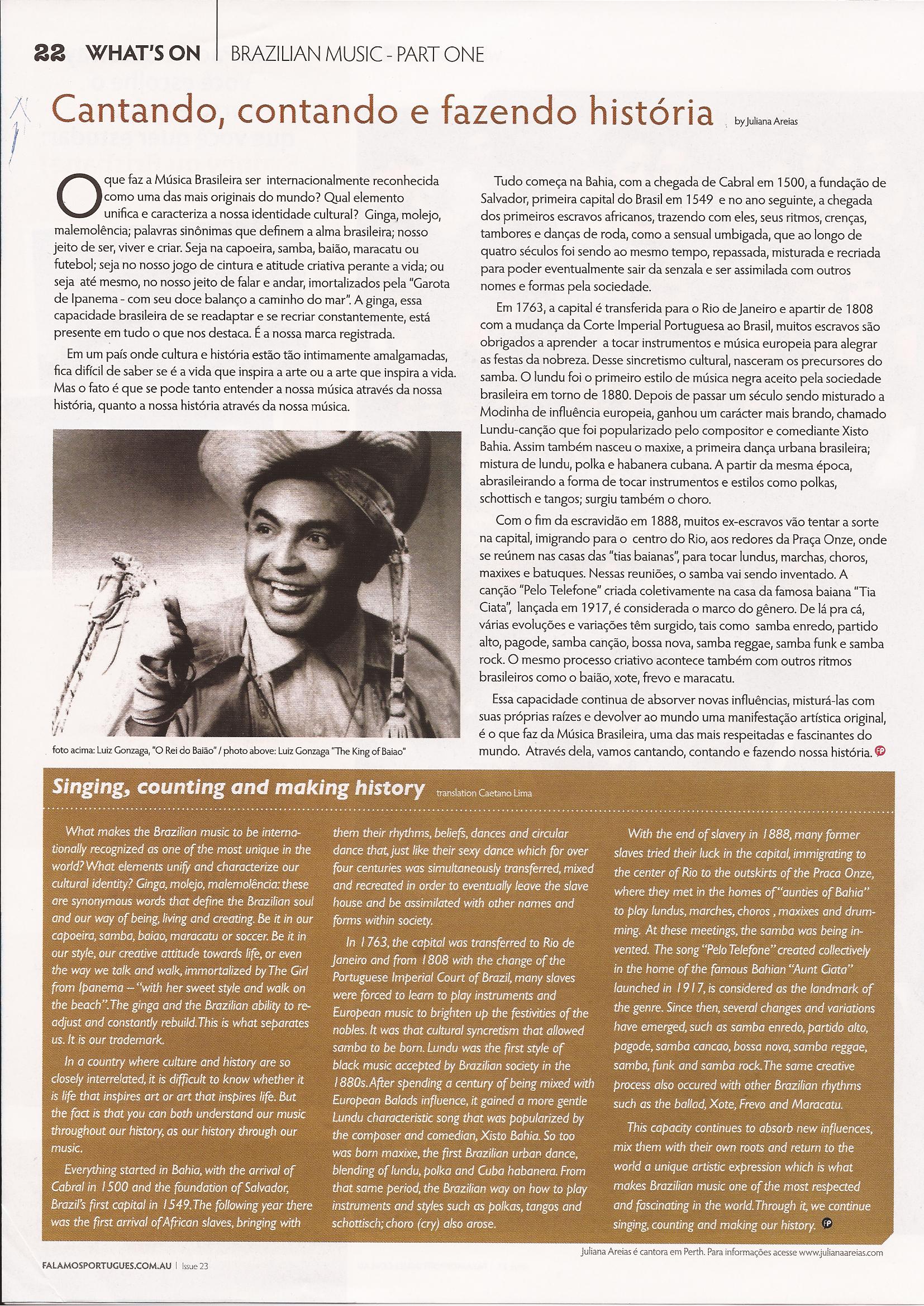
Brazilian Music – Part 1 – Introduction -  December 2010 – Issue 23

BRAZILIAN MUSIC PART 1 – Singing, telling and making history.

What makes Brazilian Music internationally recognised as one of the most authentic musical expressions of the world? Which elements unify and characterize our cultural identity? “Ginga, molejo, malemolencia”: these are synonymous words that define the Brazilian soul and the Brazilian way of being, living and creating. Be it in the expression of capoeira, samba, baiao, maracatu or soccer. Be it in our flexible and creative attitude towards life, or be it even in the way we talk and walk, immortalized by ” The girl from Ipanema” song: ” When she walks she’s like a samba that swings so cool and sways so gentle”. The “Ginga” is the Brazilian ability to readjust and constantly recreate. It is the Brazilian cultural signature, its malleable bilateral motion and spirit  present in the everyday life and all our forms of expression. It is what makes us always keeping in rhythm – no matter what. It is our trademark.

In a country where culture and history are so closely interrelated, it is difficult to know whether it is life that inspires art or art that inspires life. But the fact is that we can understand both our music through our history, as our history through our music.

The cultural blending began in Bahia, with the arrival of the Portuguese Fleet led by Cabral in 1500s with their first contact with the Native Brazilian  indiginous tribes and the foundation of Salvador City, Brazil’s first capital in 1549. The following year, the first African Slaves arrived in Brazil, bringing with them, their rhythms, beliefs, drums and their circle dance style, such as the sensual “umbigada” -  a dance in which two people meet in the middle of a dance circle and their belly buttons (umbigos) must connect. This “umbigada” dance evolved for over four centuries, being simultaneously learned, mixed , transformed and recreated by the new generations,  eventually leaving the slave houses and becoming assimilated with other names and forms within society.

In 1763, the capital was relocated to Rio de Janeiro. From 1808 when the Portuguese Imperial Court moved to Brazil to scape from Napoleon, many African slaves were forced to learn how to play European instruments and European Music in order to intertain the nobles. This cultural syncretism process allowed the samba precursors to be born.  “Lundu” was the first style of African music accepted by Brazilian society in the 1880′s. After spending a century of being mixed with a European music style called “Modinha”, it gained softer characteristic that was popularized by a composer and

Xisto Bahia

comedian known as Xisto Bahia. So too was born Maxixe, the first Brazilian urban dance, a blending of lundu, polka and Cuban Habanera. From that same period, the  “Choro” (or “Chorinho”) as a rhythm and style was created as a result of the Brazilian way of interpreting and mixing polkas, tangos and Scottisch rhythms.

With the abolishment of slavery in 1888, many former slaves tried their luck in the capital, moving from Bahia and  immigrating to the center of Rio de Janeiro to the outskirts of the “Praca Onze”,

Aunt Ciata

where they met in the homes of the “Aunties from Bahia” to play percussion drums,  lundus, marches, choros and maxixes. During these meetings, the samba was being invented. The “Pelo Telefone” song, created collectively at the famous Bahian “Aunt Ciata”‘s home, was lanched in 1917 and it is considerated the landmark of the genre. Since then, several changes and variations of Samba have emerged, such as samba enredo, samba cancao, bossa nova, partido alto, pagode, samba reggae, samba funk and samba rock. The same syncretic creative process also occured with the development of other Brazilian rhythms such as the baiao, xote, frevo and maracatu.

Donga, Pixinguinha and Joao da Baiana

This continuos capacity to absorb new influences, mixing them with its own roots and returning to the world an authentic artistic expression is what makes Brazilian Music one of the most respected and fascinating music of the world. Through it, we continue singing, telling and making our history.

Ze da Velha, Pixinguinha, Donga and friends

Video of Cartola em Creuza sings a “Lundu” called “Ensaboa”(“Soaping”)

Video of ” Pelo Telefone” (Donga / MAuro de Almeida) recorde on 1916 by Bahiano:

Brazilian Music – Part two -  Samba-  January  2011 – Issue 24

BRAZILIAN MUSIC PART 2 – Samba – The National Rhythm that conquered the world.

During the “Golden Age of Samba” (1920′s-1940′s), besides the coexistence of an amazing group of talented musician and composers – such as Pixinguinha, Sinho, Donga, Ismael, Assis Valente, Noel Rosa, Braguinha, Lamartine Babo, Ary Barroso and Dorival Caymmi – other external factors and key personalities were pivotal in consolidating this musical movement. The first of those elements was the “Nationalist Ideology”, promoted by the” Sao Paulo Modern Art Week Exhibition” (1922); and implemented by Getulio Vargas’s Government (1930-1945 / 1951-1954).


Sao Paulo Modern Art Week Flyer

This change of mentality represented a revolutionary transition. The Street Carnival Parade was officially recognized by President Getulio Vargas in 1935. Before this time, samba groups were  persecuted and discouraged by the police. The first “samba school” (samba group) called “Deixa Falar” was crated in 1928 and the second, called “Mangueira” in 1929. “Mangueira”still exists today.

President Getulio Vargas

Sound technology was in expansion at the same time. The first Radio Station in Brazil appeared in 1922, with only eight receivers. It became progressively more accessible from 1932. Getulio Vargas made a new law to facilitate the opening of new radio stations in Brazil in 1937. Thanks to this, radio reached its commercial peak during the 1940’s. The Cinema Sound Era began in 1920, becoming popular in Brazil during the 1930’s. By 1945 Hollywood emerged as the main centre of cinematography, following World War II and the economic crises in Europe.

Lapa in the 1930's

Combining all these circumstances and characters, with the voice and charisma of Carmen Miranda, Samba established itself in Brazil and the world. Carmen emigrated from Portugal to Rio de Janeiro when she was just a baby in 1909. She spent her adolescence in Lapa, the most bohemian suburb of Rio. Having an extraordinary group of musicians and composers around her, Carmen became the greatest star in records, radio, movies, theatre and Brazilian casinos during the 1930’s. In 1940 she was invited to debut on Broadway and ended up conquering Hollywood, immortalizing the Brazilian grace, joy and samba with songs such as “Brazil”, composed by Ary Barroso. This song is a perfect example of  “exaltation samba”. It illustrates well the nationalist atmosphere of that period.

Aurora - Carmen's sister and "Ze Carioca" in a Disney Film.

As the writter Ruy Castro recounts in his book  “Carmen – the life of Carmen Miranda, the most famous Brazilian in the Twentieth Century”; Carmen’s band’s trip to United States was directly funded by Getulio Vargas’ Government to ensure that “the real Brazilian rhythm” – would conquer the world. The “mission” was well accomplished. Since then samba has entered the world stage and with its multiple facets it continues to evolve.

Carmen and her band called "Bando da Lua"

Carmen Miranda singing “Tico-tico no fuba” :

Carmen Miranda singing ” Chica Chica Boom Chic”

Carmen Miranda at her Hollywood Mansion:

Brazilian Music – Part three – Bossa Nova -  February 2011 – Issue 25

BRAZILIAN MUSIC PART 3 – Bossa Nova – When samba and jazz fell in love forever

Bossa Nova – literally means talent and originality – it is an aesthetic and musical movement that has aspired and inspired modernity since its conseption and continues to make the modern world fall in love with it.

Influenced by the Jazz recordings that arrived in Brazil after the 2nd World War, Brazilian singer Dick Farney (known as the Brazilian Sinatra) recorded “Copacabana” in 1946. This song was one of the Bossa Nova’s precursors.

In 1950, the vocal ensemble “ Garotos da Lua” (Moon’s boys) brought Joao Gilberto from Bahia to Rio to be their new crooner. Joao had a very

"Garotos da Lua" with its crooner Joao Gilberto (top)

strong and powerful voice, like, “Orlando Silva”, who was still the standard voice of the time. However, Joao didn’t last long in the

Johnny Alf

band, not because of his vocal ability, but because instead of attending to the band’s commitments, he preferred to go the legendary “Beco das Garrafas” ( Bottles Lane) and other places around the city at night listening to musicians such as: pianist Johnny Alf ‘s different rhythmic division and the young accordionist/ pianist Joao Donato’s rich jazz harmonies.

Joao Donato

Before leaving Rio, Joao also shared a flat with “Lucio Alves”, a “cool style” singer who recorded with Dick Farney the song “ Teresa da Praia” ( Teresa from the beach) composed by Antonio Carlos Jobim and Billy Blanco in 1954. This song was Jobim’s first hit. Teresa was the name of Jobim’s first wife.

Dick Farney & Lucio Alves

In the song the two singers are rivals competing to be Teresa’s favourite lover. The song was a clever marketing analogy since in real life; there was rivalry between Dick and Lucio’s fan clubs.

In 1957, Joao returned to Rio singing softly and playing with that “different guitar beat” which was more syncopated than the traditional samba, inspired by the beat pattern of the

tamborim

“tamborim” ( a samba hand percussion played with a stick, smaller and different from the tambourine). The change was revolutionary. The youth of the time, eager for modernity,

Nara Leao, Menescal, Bebeto and Dori Caymmi at Nara's apartment flat

immediately identified with this fresh “bossa”, organising jam session parties at their comfortable upper-middle class apartments to play the new style and share their new compositions. The Copacabana apartment of Nara Leao parents was the most famous meeting place for the young musicians and composers  such as Carlos Lyra, Roberto Menescal and Ronaldo Boscoli.

Antonio Carlos Jobim

The news also reached Jobim’s ears, who envisioned new musical horizons through that rhythm (a more flexible samba, which allowed more modern and sophisticated harmonies).

Joao Gilberto & Antonio Carlos Jobim

From his archives, Jobim retrieved a “samba cancao” song he had written with poet Vinicius de Moraes called “ Chega de Saudade” (No more blues) and

Helo Pinheiro: The girl from Ipanema

recorded it for the album “Cancao do amor demais”(Song of too much love) by Elizeth Cardoso in 1958. Joao Gilberto himself accompanied her on guitar. In the same year, Joao recorded the historic 78rpm with “Chega de Saudade” on one side and “Bimbom” on the other, playing guitar and singing softly. This album, which generated much controversy and aroused strong feelings of both approval and disapproval is now considered the landmark of the Bossa Nova Movement.

The Bossa Nova President in Brasilia

The Bossa Nova reflected the atmosphere of optimism and modernism of the country. The Brazilian President Juscelino Kubitschek – known as the Bossa Nova President –  commissioned Brazilian architect, Oscar Niemeyer, to create

Pele & Garrincha - World Cup 1958

“Brasilia” the new capital of Brazil to be one of the most modern cities of the world. In 1958, Brazil won its first World Cup with the legendary players Pele and Garricha in its team. In 1959, the “Brazilian New Cinema” (“Cinema Novo”) won the Cannes Film Festival with the film Black Orpheus, based on “Orfeu da Conceicao” by Vinicius de Moraes and soundtrack by Antonio Carlos Jobim and Luiz Bonfa. Bossa nova was attracting the world’s attention and soon the jazz which had influenced its creation began to be influenced by it in turn.

Sinatra & Jobim

Sinatra & Jobim

Helo & Jobim

The passion became clearly reciprocal from 1962 when Antonio Carlos Jobim was acclaimed at the Carnegie Hall in New York. Stan Gets recorded with Jobim, Joao Gilberto and Astrud Gilberto, the immortalized version of “The girl from Ipanema” in 1963 and since then celebrities such as Frank Sinatra, Sarah Vaughan, Nat King Cole and more recently Diana Krall,  Herbie Hancock, George Michael, Sting and Black Eyed Peas have continued on “dating” our bossa.

At Nara's apartment in 2010: Menescal , Wanda Sa, Joyce, Joao Donato, Leila Pinheiro, Marcus Valle, Leny Andrade and others

Believe it or not, here is Joao Gilberto singing with his previous ” strong and powerful” voice style. Check it out:

Luiz Bonfa, Joao Gilberto and Antonio Carlos Jobim singing ” Cancao do MAr” at the Film”Copacabana Palace”.

Sinatra and Jobim performing together in 1967:

Brazilian Music- Part four – MPB and Tropicalia -  March/April 2011 – Issue 26

Brazilian Musical movement of from 1964-1884

BRAZILIAN MUSIC PART 4 – MPB and Tropicalia – The borderless music that fooled a dictatorship

Text in English:

From 1964 to 1984, Brazil was under a military dictatorship, when many people were killed, imprisoned, persecuted and exiled. During the 10 years of that period, there was no freedom of expression. Every song, before being released, had to be approved by government censorship. Still, or perhaps for that reason, this was one of the greatest periods of musical diversity in Brazil, with an explosion of new names, genres and creativity. The song was the most powerful weapon the youth used against the Brazilian dictatorship.

During the military regime, there were only two political parties: the “Arena”, representing the government itself, and the MDB (Brazilian Democratic Movement), the opposition party, incorporating all parties that had been destroyed by the coup. Interestingly, in the music scene, a similar term was created: the MPB (Popular Brazilian Music) generalising and representing, regardless of style, all the great artists who emerged from the TV and University Music Festivals of that time: Chico Buarque, Edu Lobo, Elis Regina, Geraldo Vandre, Gilberto Gil, Caetano Veloso, Os Mutantes, Ivan Lins, Milton Nascimento, Joao Bosco, Jorge Benjor, Wilson Simonal, Nana Caymmi, Dori Caymmi, Luiz Melodia and Djavan.

Inspired by the “cultural cannibalism” idea proposed at the “Anthropophagite manifesto – 1928” by writer Oswald de Andrade, the musical movement known as “Tropicalia” appeared  mixing without prejudice, all kinds of influences: Brazilian rhythms – such as baiao, bossa, samba – with Beatles,  African rhythms, funk, Chuck Berry, Jean-Luc Godard and etc. The main names of Tropicalia were:  Caetano Veloso, Gilberto Gil, Gal Costa, Maria Betania, Tom Ze, Torquato Neto, Capinam and Os Mutantes (attraction of the Perth International Festival in 2011). The “tropicalists” were the first to mix rock with Brazilian rhythms which, at first, shocked even the young audience that booed when Caetano sung “Alegria Alegria” (Joy Joy) in 1967 and ” E proibido proibir” (It is prohibited to prohibit) with Os Mutantes in 1968. Tropicalia’s  hippie, anarchist and libertarian attitude bothered the military regime, thus Caetano and Gil, the leaders of the movement, were arrested in 1969 and went into exile in London until 1972. The songs “Aquele abraco” (big hug) by Gil and “London London” by Caetano portray their after prison and exile periods respectively.

The song “Pra nao dizer que nao falei das flores” (Not to say I didn’t speak of the flowers) by Geraldo Vandre, explicitly protested against the dictatorship and became a sort of anthem of this period. Vandre was arrested, had his work banned resulting in quite a shortened career. However, from his backup bands emerged some of the most legendary Brazilian instrumentalists: Hermeto Pascoal, Airto Moreira and Nana Vasconcelos. Other landmarks of the time were Chico Buarque’s songs:  ”Apesar de voce” (Despite Yourself”) and “Calice” (chalice)- in partnership with Gil. The word “calice” translates as “Chalice” yet is a homonym of the phrase “cale-se”, which means “shut up”.  Unlike Vandre, Chico, protested using metaphors. He was never arrested, but he was certainly a favourite target for the censors, getting to the point of having to create a fake name to sign his songs, as the only way of having some of them approved by the censorship body.

Until today Caetano, Gil and Chico are renowned artists in Brazil and abroad. Chico continues to create fantastic lyrics and he is a celebrity in Italy and France. Caetano remains a very controversial figure and he is always being invited to record with artists such as David Bowie. He had performed with Lila Downs, the song, “Burn it Blue” (soundtrack of the movie Frida) at the Oscar’s in 2003. Gil, who was the Minister for Culture 2002-2008, continues to perform at major events such as The Montreux Jazz Festival, sharing the stage with stars such as Stevie Wonder and Quincy Jones. His song “Aquele Abraco” (big hug),” which he composed after he left prison, will be the theme song of the Olympic Games in Rio in 2016. It’s no wonder, as the lyrics of this song begin ” Rio continues to be beautiful….”


Text in Portuguese:


Gilberto Gil’s song “Aquele Abraco” – as the theme for the Olympic Games in Rio in 2016:

Gil and Chico Buarque singing ” Calice” in 1973

Caetano Veloso and Lila Downs – Oscar 2003 performing Burn it Blue (Soundtrack of the movie Frida):

Gilberto Gil and Steve Wonder – Desafinado:

Brazilian Music- five – 80′s Brazilian Pop Rock – May/June 2011 – Issue 27

Brazilian Musical movement of from 1980-1989.

BRAZILIAN MUSIC PART 5 – 80′s Brazilian Pop Rock – “Two steps from paradise” and democracy

The 80’s in Brazil: While the headlines warned about AIDS and the country took its first steps towards democracy  whilst facing the highest inflation rate in its history (85% per month!); the Brazilian urban youth –  sons of the dictatorship, censorship, television and the consumer society – also sought to reinvent their place within this new context. Thus emerged Brazilian Pop Rock: irreverent, uncompromising and free to openly portray their desires and their reality.

By analysing the names of the songs of this period, we can see how this generation, who were accused of being superficial, banal and alienated, were well aware of these accusations but not worried about proving anything to anyone: “You didn’t know how to love me”, “Guess what”, “Coca-Cola generation, ” “Waste of time”, “Useless,” “Rebel without a cause,” “We’ll invade your beach,” “Police”, “Primate human,” ” Gross animals ,” “My fault,” “Boredom,” “Decadence avec elegance”, “ Abandoned grown up,” “Fleeting” and “We are who we can be.” With this attitude, “Almost by contradiction”, its lyrics ended up impressing and some of it’s composers, began to be respected as “poets,” having their songs re-recorded continuously: Renato Russo ( Legião Urbana) and  Cazuza ( Barao Vermelho) – both victims of AIDS;  Arnaldo Antunes (Titas) and Herbert Vianna (Paralamas do Sucesso).

Musically, the main influences were rock, pop, new wave and punk. The “Paralamas do Sucesso” were also highlighted as one of the only bands of the period who successfully mixed rock with other styles such as reggae, ska, African and Latin rhythms; introducing horns to their arrangements.

In 1985, the Brazilian entrepreneur Roberto Medina,  motivated by the potential of the movement, produced the largest Rock Festival of all time, Rock in Rio I, which had an audience of nearly 1.5 million people (equivalent to five times that at Woodstock) . The festival got global media coverage by uniting national icons – such as: Barao Vermelho, Blitz, Eduardo Dusek, Kid Abelha, Lulu Santos, Paralamas do Sucesso, and  Rita Lee – with international stars such as : Queen, AC / DC, Al Jarreau, The B -52 ‘s, George Benson, The Go-Go’s, Iron Maiden, James Taylor, Nina Hagen, Ozzy Osbourne, Rod Stewart, Scorpions, Whitesnake and Yes. However, the only Brazilian  metal band recognized in the international Rock circuit today is Sepultura.

The list of the major artists who gained national prominence includes:

- From Brasilia and Goias: Legião Urbana, Capital Inicial, Plebe Rude, Finis Africae and Leo Jaime.

- From Rio Grande do Sul: Engenheiros do Hawaii and Nenhum de nos.

- From Minas Gerais: 14 Bis and Sepultura.

- From Bahia: Camisa de Venus, led by Marcelo Nova, bringing up again the genius of Raul Seixas (music partner of Paulo Coelho, author of “The Alchemist”).

- From Sao Paulo: Ultrage a Rigor, Ira, Titans, Kid Vinil, Metro, Gang 90, RPM, Radio Taxi, Zero, Kiko Zambianchi and  Rita Lee (ex Os Mutantes).

- From Rio de Janeiro: Blitz, Barao Vermelho, Lobao, Paralamas do Sucesso, Kid Abelha, Sempre Livre, Herva Doce, Absyntho,  Ritchie, Lulu Santos, Eduardo Dusek, Marina, Roupa Nova, Biquini Cavadao, Hojerizah, Inimigos do Rei (with Paulinho Moska), Uns e outros, Herois da Resistencia, Egotrip e Picassos Falsos – whose bassist Jose Henrique Alves, is now an Australian citizen, a member of So Brazil duo, a voice and guitar duo, formed in Perth in 2009, featuring new acoustic versions of 80’s Brazilian and international rock songs. (www.sobrazil.wordpress.com).

Rock in Rio 1985 – Barao Vermelho – Pro Dia nascer feliz – ( Frejat/ Cazuza) -

with lyrics translation ” For the sun to rise happily”

Rock in Rio 1985 – Paralamas do Sucesso – “Meu Erro” – My fault ( Hebert Vianna)

Legiao Urbana – Tempo Perdido – ” Waste of time” ( Renato Russo)

Lobao @ Hollywood Rock 1990

Titas and Sepultura – Policia

Picassos Falsos – Carne e Osso – 1987 ( featuring Brazilian/ Australian bassist Jose Henrique Alves)

Raul Seixas and Paulo Coelho – Sociedade Alternativa “Alternative Society”

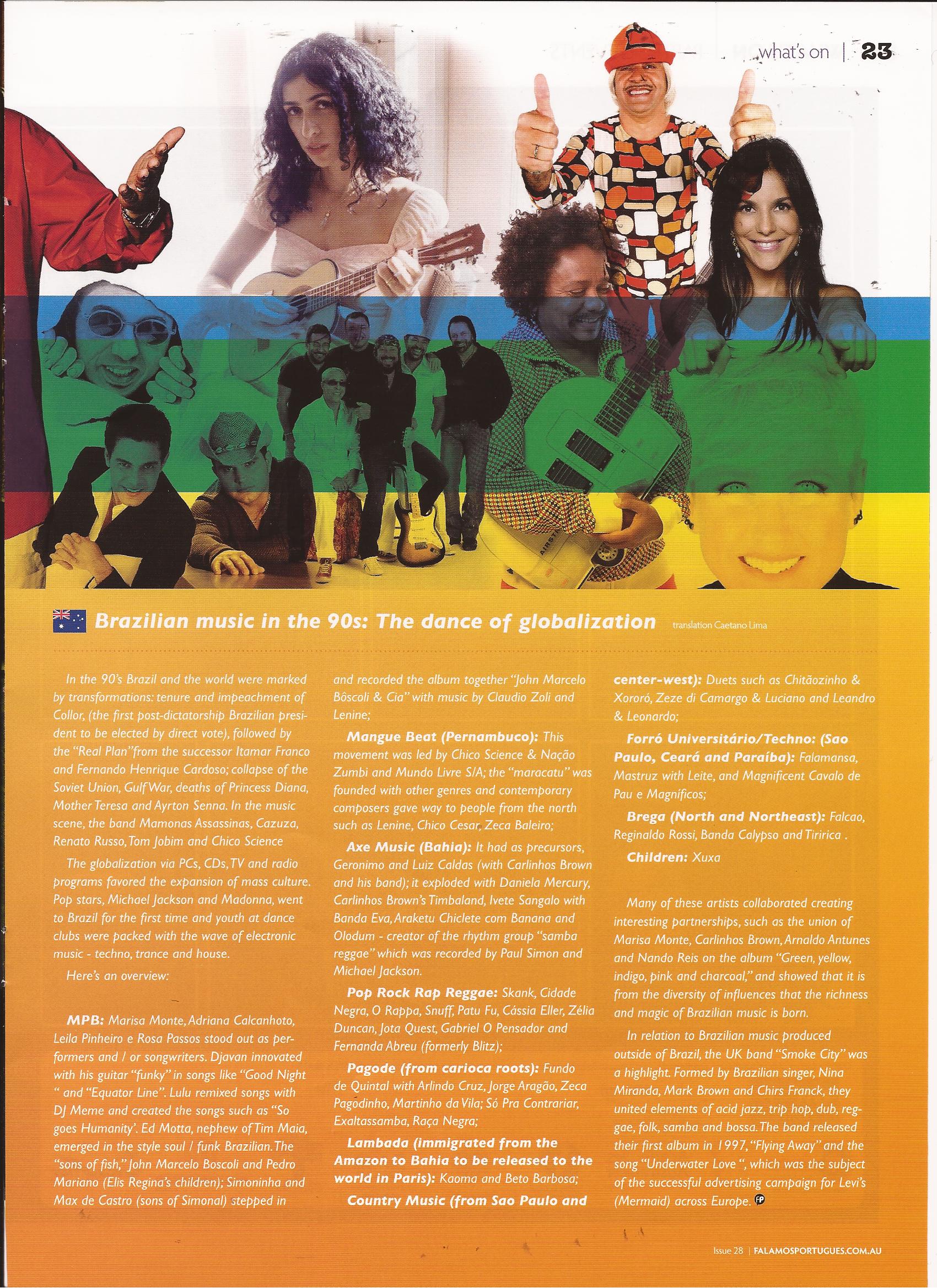
BRAZILIAN MUSIC PART 6 – 90′s Brazilian Music – The dance of Globalization (translation by Juliana Areias and Sue Burns)

In the 90′s Brazil and the world were marked by transformations: election and impeachment of Collor, (the first post-dictatorship Brazilian president to be elected by direct vote), followed by the economic “Real Plan” created by his successors Itamar Franco and Fernando Henrique Cardoso; collapse of the Soviet Union, Gulf War, deaths of Princess Diana, Mother Teresa , Ayrton Senna and from the music scene, deaths of : the band Mamonas Assassinas, Cazuza, Renato Russo, Antonio Carlos Jobim and Chico Science.

The globalization via PCs, CDs, TV and radio programs promoted the expansion of mass culture. Pop stars, Michael Jackson and Madonna, went to Brazil for the first time and the youth enjoyed dancing to the new electronic music – techno, trance and house – in night clubs.  Here’s an overview of this period:

MPB ( Brazilian Popular Music) : Marisa Monte, Adriana Calcanhoto, Leila Pinheiro e Rosa Passos stood out as singers and / or songwriters. Djavan innovated with his “funky” guitar groove in songs like “Boa Noite” (Good Night)  and “Linha do Equador” (Equator Line). Lulu Santos working with DJ Meme remixed his songs creating dance hits such as “Assim caminha a Humanidade” (So goes Humanity). Ed Motta, following his Uncle Tim Maia’s footsteps, emerged as a Brazilian soul / funk singer. Like begets like,  Joao Marcelo Boscoli and Pedro Mariano (Elis Regina’s sons); Simoninha and Max de Castro (Wilson Simonal’s sons ) appeared in the music scene recording an album together “Joao Marcelo Bôscoli & Cia” which included songs by Claudio Zoli and Lenine;

Mangue Beat (Pernambuco): This movement was led by Chico Science & Nação Zumbi and Mundo Livre S/A. Mixing “maracatu” rhythm with other contemporary genres, they carved a pathway for other Brazilian north-eastern  composers such as Lenine, Chico Cesar, Zeca Baleiro;
Axe Music (Bahia): Its precursors were  Geronimo and Luiz Caldas (with Carlinhos Brown at his band) who created the “fricote” style. The great stars of Axe Music were: Daniela Mercury, Carlinhos Brown with  Timbalada. Ivete Sangalo with Banda Eva, Araketu,  Chiclete com Banana and Olodum – creator of the rhythm “samba reggae” which was recorded by Paul Simon and Michael Jackson.

Pop Rock Rap Reggae: Skank, Cidade Negra, O Rappa, Mamonas Assassinas, Patu Fu, Cássia Eller, Zélia Duncan, Jota Quest, Gabriel O Pensador and Fernanda Abreu (former member of Blitz);
Pagode (from carioca roots): Fundo de Quintal with Arlindo Cruz, Jorge Aragão, Zeca Pagodinho, Martinho da Vila; Só Pra Contrariar, Exaltassamba, Raça Negra;

Lambada (Born in the Amazon Region it reached Bahia to then be released to the world via Paris): Kaoma and Beto Barbosa;

Musica Sertaneja – Brazilian Country Music (from Sao Paulo and the central-west): Duets such as Chitãozinho & Xororó, Zeze di Camargo & Luciano and Leandro & Leonardo;

Forró Universitário /Eletronico- Brazilian Pop Folk Music : (Sao Paulo, Ceará and Paraíba): Falamansa, Mastruz with Leite, and Magnificent Cavalo de Pau e Magníficos;
Brega – Cheesy Music (North and Northeast): Falcao, Reginaldo Rossi, Banda Calypso and Tiririca .
For kids : Xuxa

Many of these artists collaborated creating interesting partnerships, such as the union of Marisa Monte, Carlinhos Brown, Arnaldo Antunes and Nando Reis on the album “Green, yellow, indigo, pink and charcoal,” proving again that it is the diversity of influences that creates the richness and magic of Brazilian music.

Regarding Brazilian Music produced outside of Brazil; the UK band, “Smoke City” was a highlight. Formed by Brazilian singer, Nina Miranda, Mark Brown and Chris Franck, the band created an interesting fusion of acid jazz, trip hop, dub, reggae, folk, samba and bossa. They released their first album in 1997, “Flying Away” and their single “Underwater Love” became a hit across Europe, after being used in a Levi television advertisement “Mermaids”.

RECCOMENDED BOOKS

- “The Thrill of Making a Racket : Nietzsche, Heidegger and Community Samba in Schools” - by Dr. Christopher Naughton, PhD. in Music Education / Founder and director of the “Free Samba Project” of  The University of Auckland . Juliana Areias was part of  the “Free Samba Project ” as a Brazilian Music expert , performer, facilitator and research assistant.
http://www.amazon.com/Thrill-Making-Racket-Nietzsche-Heidegger/dp/3639124367


(English Version – “Bossa Nova – the story of the Brazilian Music that Seduced the world” by Ruy  Castro) : http://www.amazon.com/gp/product/1556524943/ref=s9_simz_gw_s0_p14_i3?pf_rd_m=ATVPDKIKX0DER&pf_rd_s=center-2&pf_rd_r=0914G7GQ5PVX9PSZDZQR&pf_rd_t=101&pf_rd_p=470938631&pf_rd_i=507846


“Chega de Saudade” – a historia e as estorias da Bossa Nova” by Ruy Castro. (In Portuguese, about Bossa Nova -around  1950′s-1960′s). http://www.amazon.com/Chega-saudade-historia-historias-Portuguese/dp/8571641374

- Carmen – A vida de Carmen Miranda, a brasileira mais famosa do seculo XX by Ruy Castro. ( In Portuguese, about Samba - around 1920′s-1940′s).

- ” Nada sera como antes – MPB nos anos 70″ by Ana Maria Bahiana. (In Portuguese, about MPB – Brazilian Popular Music – around 1970′s). http://www.tradepar.com.br/detalhes/bahiana-ana-maria–nada-sera-como-antes-mpb-anos-70-30-anos-depois-8587864947-682.html

” Quem tem um sonho nao danca – cultura  jovem brasileira nos anos 80″ by Guilherme Bryan. ( In Portuguese, about Brazilian Pop- Rock mouviment -around 1980′s).  http://openlibrary.org/b/OL22612418M/Quem_tem_um_sonho_nao_danca_cultura_jovem_brasileira_nos_anos_80

- ” The Brazilian Sound – Samba, Bossa Nova and the Popular Music of Brazil” – by Chris McGowan and Ricardo Pessanha. http://www.amazon.com/Brazilian-Sound-Chris-McGowan/dp/1566395445

RECCOMENDED DOCOS

brasilbrasil

“Brasil, Brasil” -  BBC documentary series

Episode 1: Samba to Bossa

The first programme tells the story of Brazilian music styles and rhythms: samba ( chula, samba-de roda, chorinho, samba-cancao, bossa-nova) and  forro (baio, xote, xaxado, coc0).

The series starts in the days of slavery, when an estimated 4 million Africans were forcibly moved to Brazil, and traces the development of samba from the poor black areas of Salvador and Rio, where it was initially banned, to its fusion with European styles and its move to the mainstream.

The programme follows the career of samba’s most successful and glamorous international stars, Carmen Miranda, Antonio Carlos Jobim and the growth of the samba schools that dominate the Rio carnival. It traces the fight-back by musicians from the Northeast, Luiz Gonzaga and shows how politics helped the development of samba and bossa nova (Presidents Getulio Vargas and Juscelino Kubitschek).

Samba to Bossa part 1

Samba to Bossa part 2

Samba to Bossa part 3

Samba to Bossa part 4

Samba to Bossa part 5

Samba to Bossa part 6

Samba to Bossa part 7

Episode 2: Tropicalia Revolution

The second programme in the series covers the military era in Brazil, from 1964-85, and discusses the role that musicians played in leading the fight-back – and how they suffered as a result. The programme chronicles the careers of the tropicalia stars, from Os Mutantes to Gilberto Gil and Caetano Veloso, who were both jailed and exiled to Britain (and includes never shown footage of them both performing at the Isle of Wight festival). It describes the military censorship campaign against such leading musicians as Chico Buarque, Milton Nascimento, and even Jorge Ben(jor). And it shows how black musicians in Bahia state responded by developing new, and often militant black styles like samba-reggae.

Tropicalia Revolution part 1

Tropicalia Revolution part 2

Tropicalia Revolution part 3

Tropicalia Revolution part 4

Tropicalia Revolution part 5

Tropicalia Revolution part 6

Episode 3: A Tale of Four Cities (Recife, Sao Paulo, Rio de Janeiro and Salvador)

The final programme examines the widely varied musical scene across Brazil today, and the way that songs still have a political importance in highlighting the gulf between rich and poor, black and white. From Chico Science, Lenine , Mangue beat to Suba, Marcelo D2, Seu Jorge and Axe music.

A tale of 4 cities part 1

A tale of 4 cities part 2

A tale of 4 cities part 3

A tale of 4 cities part 4

A tale of 4 cities part 5

A tale of 4 cities part 6.

One Response to Brazilian Music Publications

  1. Pingback: Juliana Areias Bio « Juliana Areias's Blog

Leave a Reply

Fill in your details below or click an icon to log in:

WordPress.com Logo

You are commenting using your WordPress.com account. Log Out / Change )

Twitter picture

You are commenting using your Twitter account. Log Out / Change )

Facebook photo

You are commenting using your Facebook account. Log Out / Change )

Connecting to %s